
5 Client Carbon Commitments
The UK construction industry and builds and maintains the infrastructure that we all need as we go about our daily lives, and is vital to the country’s economic prosperity.
However, it is also a significant contributor to national carbon emissions, and it is time to take action. CO2nstructZero is calling upon major clients to act with the launch of our Five Client Carbon Commitments – simple, practical steps that clients can take to show how they are reducing their carbon emissions, and by when.
Emerging from a previous CO2nstructZero Sprint Project, more than £30 billion of major projects from ten major clients have now made a public commitment to reduce carbon, representing around 13% of the construction market in the UK.
Five Client Carbon Commitments:
The industry’s five point plan to transition construction to Net Zero. We will…
01.
Procure for low carbon construction and provide incentives in our contracts.
02.
Set phase out dates for fossil fuel use.
03.
Eliminate the most carbon intensive concrete products.
04.
Eliminate the most carbon intensive steel products.
05.
Adopt PAS 2080, Carbon Management in Infrastructure, as a common standard.
Committed to date:
We welcome the leadership demonstrated by Anglian Water, East West Rail, Environment Agency, Heathrow, Lower Thames Crossing, National Highways, Northumbrian Water Group, Scottish Water, Sellafield Ltd, and Transport for London.
We’re inviting other organisations to join them. Get in touch with the CLC today.









What is the five point plan?
- The five-point plan is a client led approach to creating clear demand for transition to net zero within the construction industry.
- Each client will make five simple commitments.
- The framing and communication of the commitments is consistent.
- The level of ambition is up to each organisation.
- The five-point plan was launched in the spring of 2024 at an Executive level event, co-sponsored by the Construction Leadership Council, Infrastructure Client Group, Infrastructure and Projects Authority, and the Major Projects Association.
What does it mean in practice?
Details of the commitment, and what it means in practice, can be found below.
Click on a heading to explore a commitment in more detail.
1. Procure for low carbon construction and provide incentives in our contracts
What this commitment means:
An organisation must set the date by which:
- Low carbon construction will be part of the criteria for the awarding of its contracts.
- Incentives to reduce carbon emissions from construction will be included in new contracts.
Why this commitment is important:
The opportunity to signal demand for low carbon construction is in the way that we buy. If low carbon ambition and requirements are not part of a construction contract, they are unlikely to happen.
About contracts:
- Procurement and contracting approaches will vary between clients.
- Low carbon can be incorporated into any construction contract.
- Some standard form contracts now have optional carbon incentive clauses so there is no need for new drafting, e.g. NEC4 X29.
2. Set phase out dates for fossil fuel use
What this commitment means:
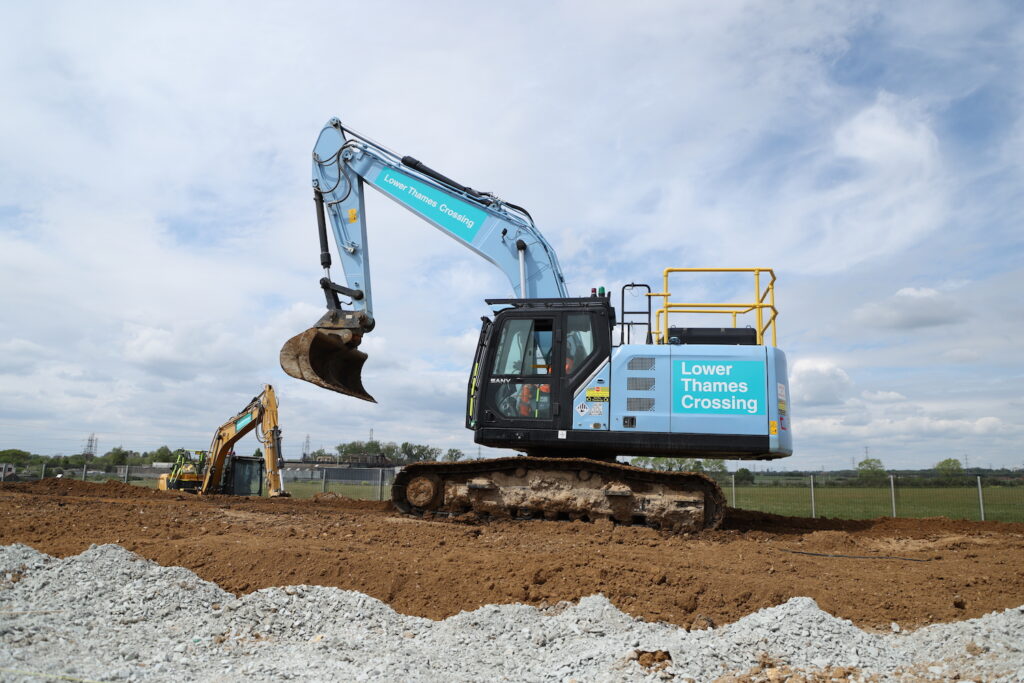
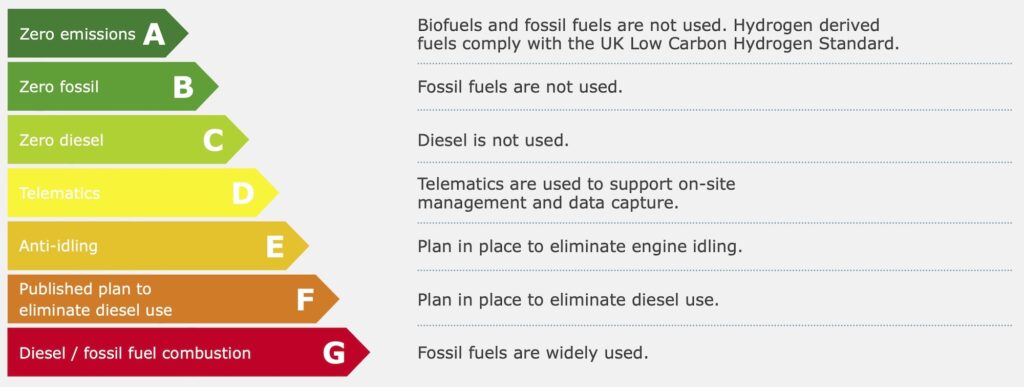
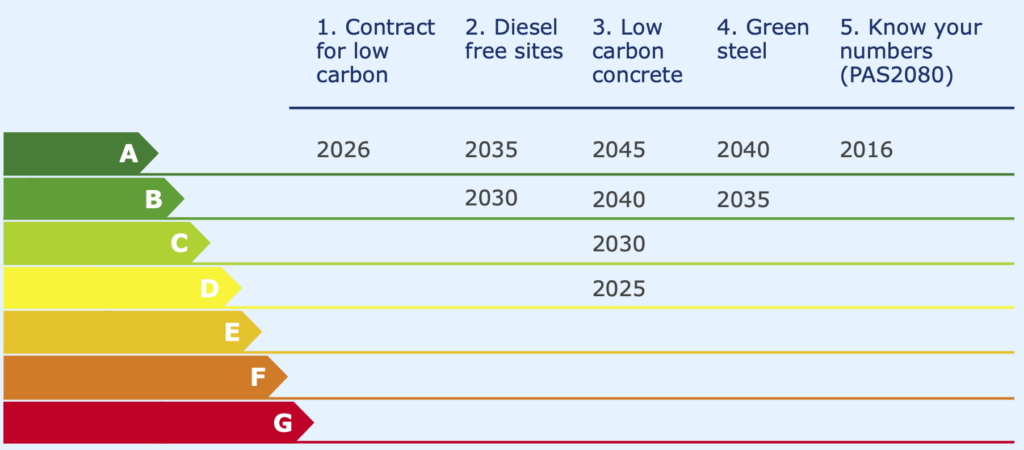
An organisation must set the dates by which its construction sites will attain the levels on the diesel free sites scale. The commitment relates to the use of equipment on construction sites.
Why this commitment is important:
It is estimated there are over 300,000 items of Non-Road Mobile Machinery (NRMM) in use across the UK construction sector. These include excavators, bulldozers, cranes, haulers, and many other machines.
Typically, they are powered using diesel engines. Many are considered “hard to abate”, due to very high-power demand and duration of use, compared with the more common applications of diesel engines in road transport.
Most construction NRMM are manufactured solely for use in this industry. Fossil free and zero emissions NRMM will only be developed and manufactured if there is clear demand for these products.
About this scale:
3. Eliminate the most carbon intensive concrete products
What this commitment means:
An organisation must set the dates by which its construction sites will attain the levels on the low carbon concrete scale. The commitment relates to all concrete applications.
Why this commitment is important:
Concrete is the world’s most used construction material. It is responsible for about 8% of global emissions. The cement within concrete is responsible for most of the carbon emissions associated with concrete. This is due to the high levels of energy used and the chemistry of breaking limestone down from CaCO3 to CaO during cement manufacture. The concrete and cement industry must invest heavily to reduce the carbon intensity of the products in the market, and this needs clear client demand for low carbon.
Innovate UK have introduced a mechanism to support clear client demand, helping to unlock investment and insurance products that can accelerate the development and deployment of low-carbon concrete solutions. Learn more here.
About this scale:
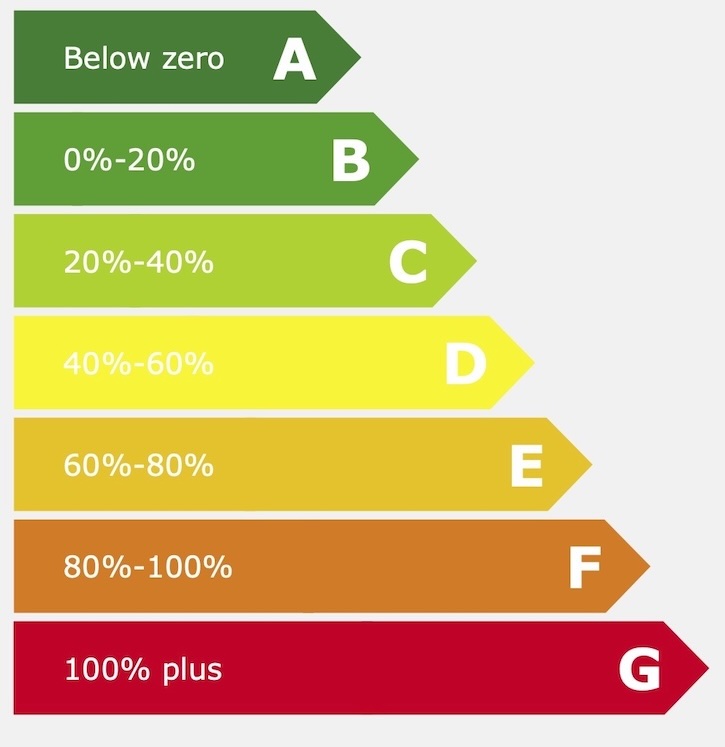
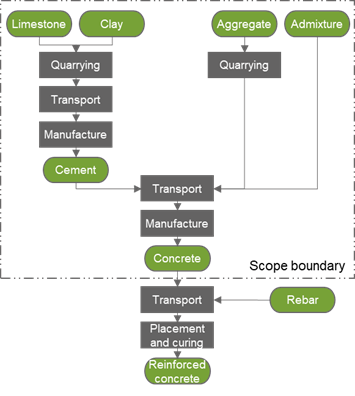
The low carbon concrete scale is expressed using percentage bands of a baseline carbon intensity. The baseline carbon intensity is defined for each concrete strength class so that the banding provides a consistent level of ambition for all strength classes.
The scope of the carbon calculation includes quarrying and transport of raw materials and the manufacture of cement and concrete. It excludes transport from the place of manufacture, placement, curing and reinforcement.
Any carbon sequestration – where carbon is captured from the atmosphere and permanently stored in the concrete during its production – can be included in the calculation of carbon intensity but offsetting cannot be used.
Full definition of the scale is provided in the Embodied carbon classification scheme for concrete, published by UKRI and Arup in 2023.
4. Eliminate the most carbon intensive steel products
What this commitment means:
An organisation must set the dates by which its construction sites need to attain the levels on the green steel scale. The commitment relates to construction products like the reinforcement used in concrete and structural steel.
Why this commitment is important:
Construction is responsible for about half of global demand for steel. Iron and steel account for about 7% of global emissions. This is largely due to the use of coke to provide heat and as a reducing agent in the manufacturing process. The steel sector must invest heavily in alternative manufacturing processes to reduce the carbon intensity of the products in the market, and this needs clear client demand for low carbon steel.
About this scale:
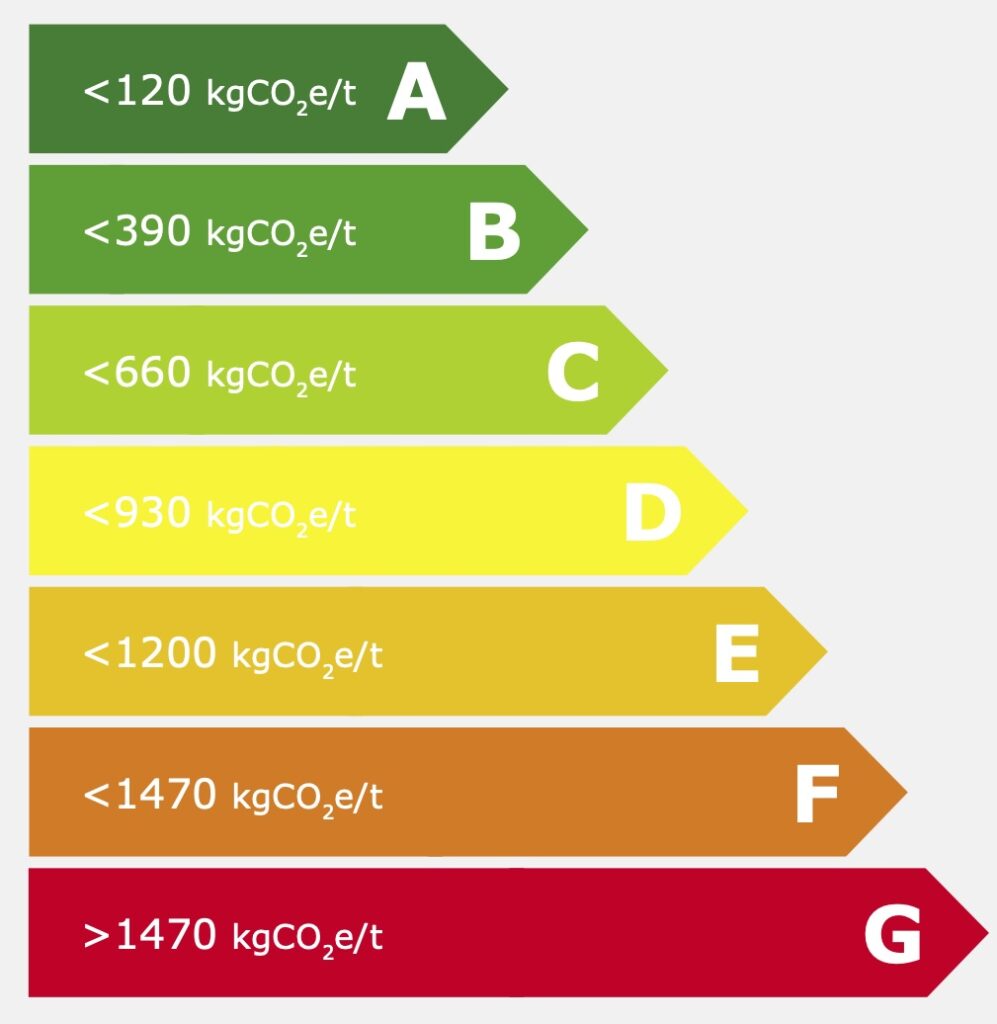
The commitment relates to construction products like the reinforcement used in concrete and structural steel.
The scope of the carbon calculation includes the quarrying, mining and transport of raw materials, and the manufacture of hot rolled steel.
Coatings, fabrication, transport to site and assembly are excluded.
Offsetting cannot be used to achieve the desired carbon intensity.
See the Global Steel Climate Council publication, The Steel Climate Standard for full details of the carbon scoping.
5. Adopt PAS 2080, Carbon Management in Infrastructure, as a common standard
What this commitment means:
An organisation must set the date by which it will achieve independent verification that its management system complies with PAS 2080.
Why this commitment is important:
It creates a consistent framework for carbon accounting and management, providing a common language for the sector during transition to net zero.
About the Standard:
PAS 2080:2023 specifies requirements for the management of whole-life carbon in buildings and infrastructure.
It has been sponsored in the UK by the Construction Leadership Council (CLC), Institution of Civil Engineers (ICE), and the Green Construction Board (GCB).
It is available free of charge and there are a number of independent bodies that can verify a management system against the standard.
Commitments made:
Explore the carbon commitments made by clients below.
Anglian Water is the largest water company by geographical area in England and Wales with a purpose to bring environmental and social prosperity to the region we serve through our commitment to love every drop.
We are committed to being carbon neutral by 2050, having already delivered a 64% reduction in capital carbon in 2024 from a 2010 baseline.
In designing and constructing ‘new build’ projects Anglian Water will:
The Environment Agency recognises the importance of committing to bold action to achieve Net Zero Carbon, while not compromising on its primary role of adaptation and resilience.
With increasing use of lower carbon materials and technology in construction, we incentivise our supply chain to apply the principles of PAS2080 and seek carbon efficiencies at the earliest stages of project development.
The Environment Agency is driving progress through:
- Procurement measures for low carbon construction, including award criteria and incentivisation of carbon reduction.
- A hierarchy in our contractor requirements driving selection of lower carbon options for construction site set-up and plant.
- Lower carbon concretes using the Market Benchmark Ratings as a minimum requirement, and a targeted accelerator project focussing on optimisation and decarbonisation in our use of concrete.
- The use of lower carbon steel sheet piles and reinforcement bar (accounting for the majority of steel used in Environment Agency projects).
- Commitment to the PAS 2080 framework and working collaboratively with our supply chain.
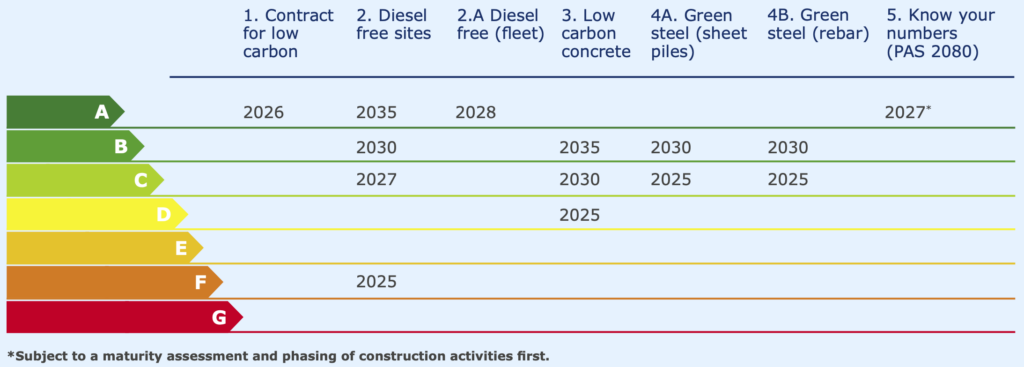
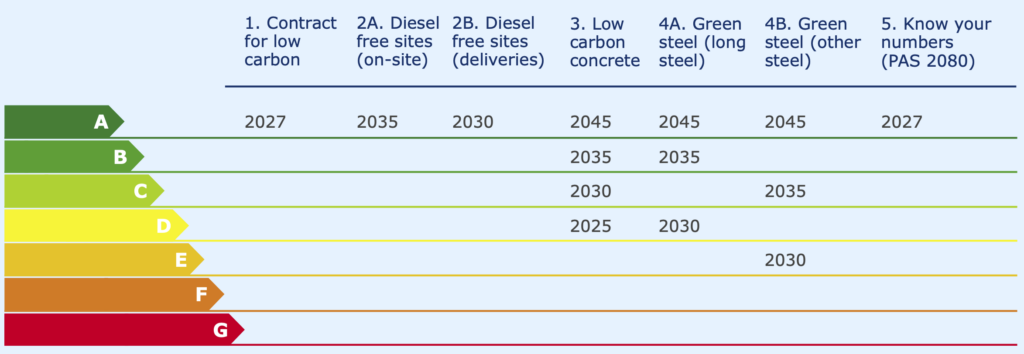
Heathrow can have a significant impact delivering carbon reduction across its supply chain. Construction is the biggest source of carbon – representing 70% of emissions in 2019.
Through collaboration with supply chain partners, Heathrow is aiming for a 35% reduction in carbon emissions by 2030 on a pathway toward achieving its 2050 net zero target.
Target table footnotes:
Heathrow is committed to sending the signal that we want to cut carbon from our construction supply chain. We cannot achieve these commitments alone – we will need the right low carbon vehicles and materials available and affordable, which will require the Government to set the right policies and our suppliers to work with us to deliver. We will keep our commitments under review with our supply chain and look to increase our commitment level where possible.
* For concrete in particular, significant volumes of high specification “Pavement Quality Concrete” (PQC) are required on the airfield – we are seeking to set individual targets for airfield, buildings and buried concrete during the remainder of this year.
** Our targets to transition to green steel reflect the volumes of long steel procured. We plan further work on our targets for embedded steel within aviation specific products such as baggage systems.
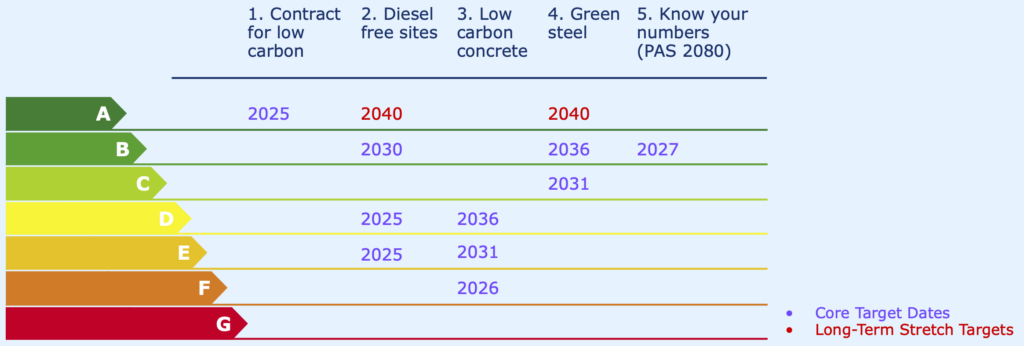
The Lower Thames Crossing is a pathfinder project, designed to be the UK’s greenest road. With clear carbon reduction ambitions, it has recently revealed a new target to reduce its construction carbon emissions by 70%.
Carbon reduction was at the heart of the procurement process and, in a UK first its Development Consent Order (DCO) application included a legally binding carbon limit.
The team has already met several commitments, including contracting for low carbon and achieving PAS 2080. Looking ahead the programme is procuring hydrogen to replace 20m litres of diesel to power heavy plant, and by 2027 all construction sites will be zero emissions with no fossil or biofuels used on site.
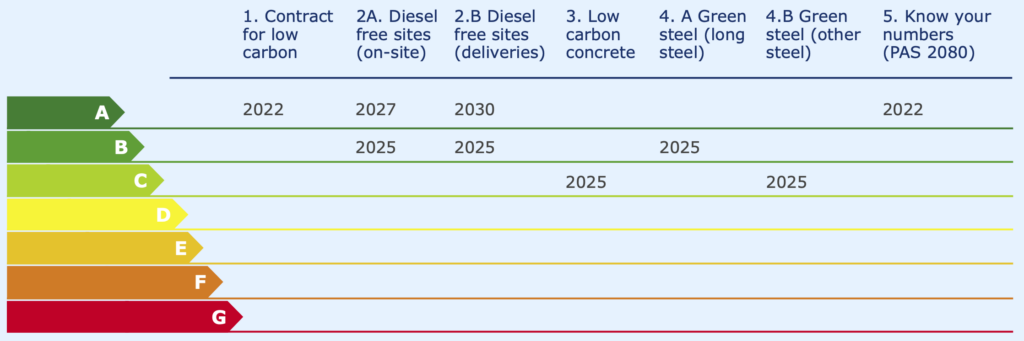
Our ambition is to achieve Net Zero for construction and maintenance by 2040. In 2021 we published Net Zero Highways, an ambitious programme that puts roads at the heart of Britain’s net zero future.
Since then, we became the first road company in the world to be validated to PAS 2080, set a carbon in contracts policy and published our roadmaps for concrete, steel and asphalt. Our Five Client Carbon Commitments are the next step towards meeting our goals.
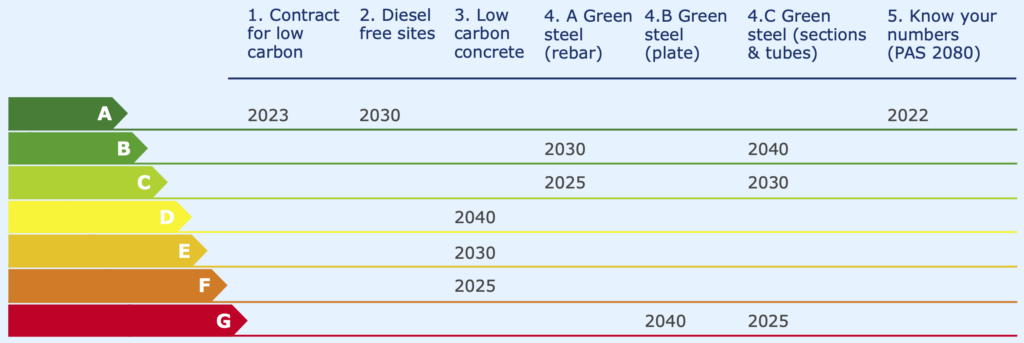
Northumbrian Water has made the commitment to achieve Net Zero emissions (Scope 1, 2 and 3) by 2050.
Over the past 15 years Northumbrian Water’s operational emissions (Scope 1 & 2) have reduced by more than 90%, and the company recently made ambitious commitments to reduce carbon emissions associated with constructing new assets.
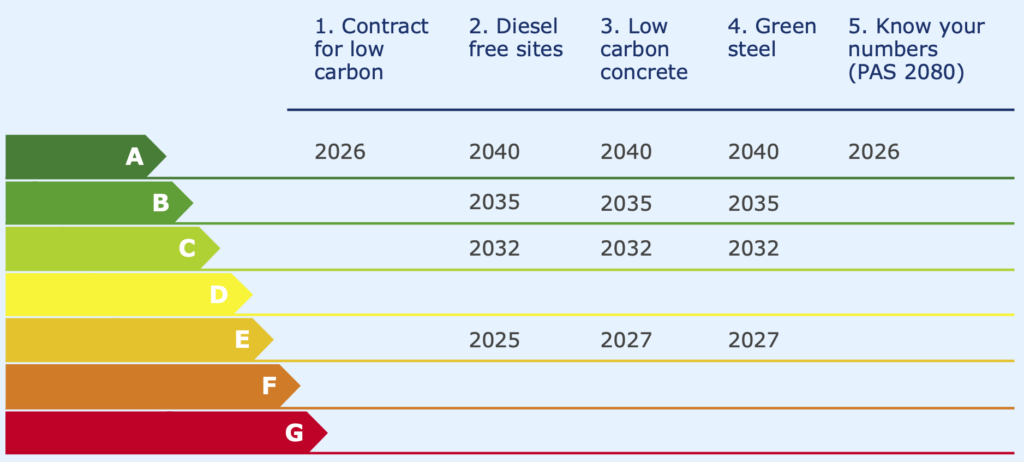
Our greatest responsibility is to manage Scotland’s public water and waste water systems, providing our customers with reliable and resilient services.
However we must do this in a way that is truly sustainable; and that is why we commit to Beyond Net Zero as we play our part in supporting a flourishing Scotland. We are committed to achieving net zero emissions by 2040 having already delivered a 25% reduction in embodied carbon in 2024 from a 2021 baseline.
In designing and constructing projects on our Capital Programme, Scottish Water aim to achieve the following commitments:
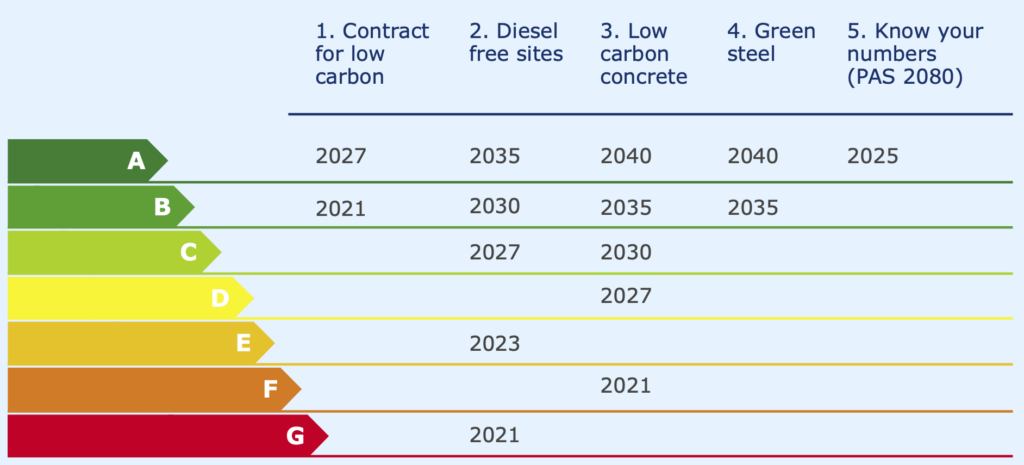
The Sellafield site has one of the most complex portfolios of construction projects in the world, helping to create a clean and safe environment for future generations.
To reach Net Zero carbon by 2050, Sellafield Ltd is embedding sustainability and low carbon practices into major projects.
As a CO2nstructZero partner, our commitments against the five topics align to industry standards to ensure benchmarking against, and learning from, other infrastructure programmes and the supply chain.
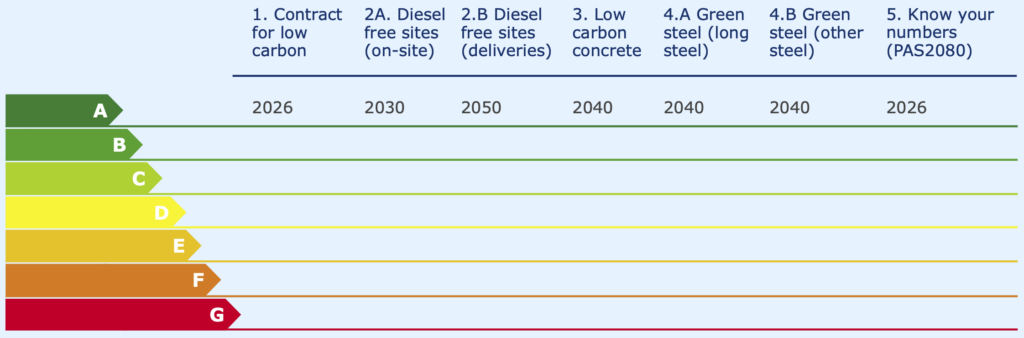
Transport for London (TfL) is committed to reducing whole life carbon emissions from its capital projects and construction activities.
Concrete and steel represent an estimated 25% and 20% respectively of the embodied emissions of TfL’s capital portfolio. TfL is aiming for a 45% reduction in its upstream carbon emissions by 2030 as part of its journey to net zero.
On new contracts, Transport for London will:
Details of East West Rail’s Five Carbon Client Commitments to be shared soon.
Hints & tips:
Considerations when adopting the five client carbon commitments.
Additional support for clients on making the commitments. Click on a heading to explore in more detail.
General considerations for adoption of the Five Client Carbon Commitments
The five client carbon commitments is about client leadership:
- It has been developed to be intuitive and easy to communicate
- It provides a consistent frame of reference so that the whole industry can use the same language.
- There is some flexibility in the implementation for individual organisations.
- You will need to create your own rules about how you monitor implementation in your organisation and how you treat exceptions.
- Try to keep the intent in mind when making these decisions and ask if they are reinforcing your leadership on net zero or whether they risk undermining it.
- Do publish updates on your progress against your commitments.
Set a review frequency:
- Long enough to provide some confidence and stability to the market.
- Short enough that you can flex to meet the needs of your business.
- Perhaps in line with a five-year regulatory cycle or other business rhythm.
Add other commitments to suit your organisation/strategy:
- The five-point plan works for all infrastructure organisations but is certainly not limiting.
- Other materials may be of specific interest to your organisation, e.g. National Highways will be setting a similar scale and commitment for asphalt.
- There are plenty of other aspects of the transition to net zero that you may want to address in your own public commitments, e.g. the Carbon Reduction Code for the Built Environment.
- Just make sure the five are included!
1. Procure for low carbon construction and provide incentives in our contracts
- Include a requirement for PAS 2080 compliance.
- Include your carbon intensity limits steel, concrete and other materials.
- Include your phase out dates for diesel.
- Consider how you will verify that your standards are being met.
- Environmental Product Declarations (EPDs) are becoming widely used and understood, other approaches may be possible.
- Consider chain of custody and matching of EPDs to products.
- Consider other elements of good practice in carbon reduction, e.g. use of the Carbon Reduction Code for the Built Environment.
- Include low carbon within your selection criteria.
- If the data is available, be specific about overall emissions limits and ambition for a contract.
- Use incentives.
- Standard form contracts now have optional carbon incentive clauses so there is no need for new drafting. e.g. NEC4 X29.
- Contracts and commercial incentives can be a great way to encourage carbon efficient design, including the “avoid” and “switch” steps, as well as the “improve” step.
- The diesel, concrete and steel commitments drive a reduction in the carbon intensity of key products, part of the “improve” step in the PAS 2080 hierarchy.
2. Set phase out dates for fossil fuel use
- The scale targets carbon, you are likely to need other requirements to address other issues associated with NRMM, e.g. specify Stage V engines to manage air quality.
- Consider applying the same approach to on-road movements to and from your construction sites.
- The sustainability of the feedstock used in biofuels can be hard to verify. Consider using more than one verification system and limiting to sourcing within trusted markets.
- There is limited global availability of sustainable biofuels.
- Oslo City has world leading policies on diesel free and zero emissions construction sites and has had significant success in transition, ahead of general market availability of zero emissions construction NRMM.
- 2030 is credible for zero emissions with several European equipment manufacturers projecting availability across multiple lines.
- 2030 is the publicly declared ambition for National Highways to achieve zero emissions construction sites.
- Big infrastructure clients are likely to need to be at zero emissions by 2035 to deliver the existing CLC commitment of 78% diesel free for the whole industry by 2035.
3. Eliminate the most carbon intensive concrete products
- The Mineral Products Association (MPA) has published an “Embodied carbon of concrete – Market Benchmark”, developed by the Low Carbon Concrete Group, in the UK.
- Overlap this data on the scale to understand where the market is today.
- The middle of the market is about D for most concrete grades.
- Any existing corporate net zero commitment date is likely to be your backstop for achieving “A” , e.g. 2040 for National Highways.
- In the absence of any other public commitment, 2050 has to be the minimum level of ambition!
- C is achievable today using high levels of GGBS as cement replacement. This is likely to become a scarce resource as steel works at Port Talbot and Scunthorpe shut down their blast furnaces, leading to greater adoption of alternatives like calcinated clays.
- A & B are likely to require breakthrough technology like CCS or approaches being pursued by Cement2zero and Brimstone.
- There are plenty of existing industry net zero publications available. The MPA have lots of resources on their website. Individual suppliers have also published their own net zero trajectories.
- Consider where you want to position your organisation, as a leader or follower.
- Remember that this is a maximum carbon intensity
- It does not limit your ability to do better in some applications of concrete.
- Make sure that your contracts support your supply chain in doing better where they can!
4. Eliminate the most carbon intensive steel products
- Consider differentiating between the two in setting your ambition.
- Long steel is used to make reinforcing steel for concrete and in other construction applications like rails and I-beams.
- In Europe, it is predominantly made in an Electric Arc Furnace (EAF) and has a relatively low carbon intensity.
- Flat steel is used in other construction applications.
- In Europe, it is typically made in a blast furnace and has a much higher carbon intensity than steel made by EAF.
- UK and Europe sourced rebar could meet a “B” or “C” today.
- UK sourced flat steel is likely to be “G” until the Tata and British Steel plants transition to EAF.
- There is likely to be availability of European sourced flat steel at “D” or better in the near term.
- Any existing corporate net zero commitment date is likely to be your backstop for achieving “A”, e.g. 2040 for National Highways.
- In the absence of any other public commitment, 2050 has to be the minimum level of ambition!
- “C” or even “B” should be achievable in flat steel, using a high recycled content and EAF
- This is already the case for re-bar / long steel
- Tata and British Steel both projecting availability of a flat steel product with high recycled content and EAF before 2030
- H2 DRI or equivalent technology will be needed to achieve “A”
- It is likely that your steel is sourced through a fabricator or other intermediary, and not directly from the steel producer
- Ask your suppliers where they source from and what other options there are
- Ask if it is possible to lower the carbon intensity of EAF produced steel by using renewable electricity or increasing the recycled content
5. Adopt PAS 2080, Carbon Management in Infrastructure, as a common standard
- Most organisations should be able to develop or update their management processes to align to PAS 2080 within about 12 months.
- Independent verification reviews are best booked well in advance.
- Consider how much of your supply chain should also align to the PAS principles to make implementation effective without being over-burdensome.
- PAS 2080 supports system wide planning for carbon reduction, following a hierarchy of “avoid, switch, improve.”
Quick Links:
Get in touch:
Interested in getting involved or have any further questions about CO2nstructZero? Get in touch with the team today.